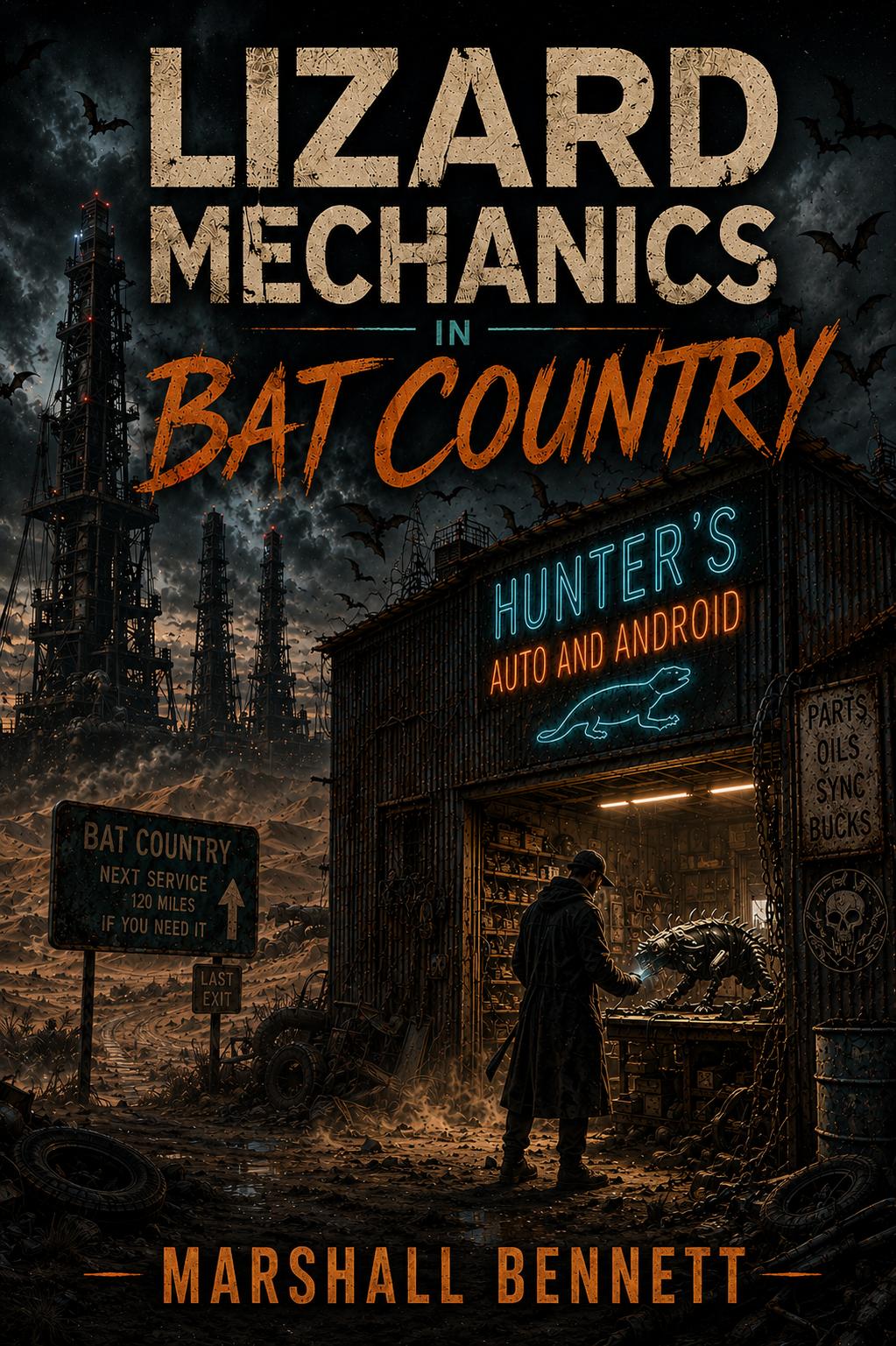
Bat Country begins where the interstate gives up and the desert starts whispering. The wind pushes dust across the empty service road, and the old drone towers hum like tired insects. People don’t come here unless something has broken—usually a machine, sometimes a man.
I fix the machines. The lizards mostly.
Long metal bodies. Heat-scored scales. Logic cores that twitch when the sun gets too mean. They were built to crawl pipelines and patrol the badlands—quiet, obedient, predictable.
But the one dragged into my shop this morning had blood dried in its joints and a memory buffer that refused to open.
Out here, that usually means only one thing.
Somebody is dead.
And the machine knows why.
By noon the desert heat had turned the workshop into a slow cooker for broken circuitry. I had the lizard unit split open across the bench, its spine of copper pins glinting under a flickering lamp. Most patrol models carry dull memories—sand levels, pipeline pressure, the occasional coyote crossing their sensors.
This one kept looping the same corrupted fragment.
A shape moving fast through the bat towers.
Gunfire.
Then the lizard turning its head, as if someone had ordered it to witness what happened next.
Machines aren’t supposed to hesitate. But the delay burned into its processor told me it had.
And out here, hesitation means someone taught the machine something it was never built to learn.
My name is Hunter.
And this is my shop.
I used to think the desert talked if you listened through the engine block. Some nights I still climb onto the hood of a dying pickup and lie there under the sodium lights where the highway peels into scrub and limestone. When the motor cools you can hear the lizards moving under the heat-cracked earth, little wrenches turning in a planetary gearbox. Out here the radio eventually loses its nerve—just static and the dry ticking of metal shrinking in the dark—and every machine starts to feel half alive, half hallucination. Sometimes I wonder if the desert is experimenting with new forms of motion, trying to decide whether blood, gasoline, or moonlight makes the better lubricant.
The man who brought the lizard didn’t stay long. He backed his truck up to the shop door before sunrise, engine idling like it didn’t trust the quiet, and slid the machine onto my floor with the careful hands of someone used to handling explosives or bodies. He never gave a name. Just said the unit had “picked up something it shouldn’t have” near the bat towers and that if its memory opened, I should forget whatever I saw. Then he left too fast, tires spitting gravel into the pale desert light.
The lizard on my bench twitched once after the truck disappeared, its damaged sensors turning slowly toward the door like it was still watching the man drive away.
Out here, machines only do that when they’re afraid of something.
I leaned closer to the open chassis and tapped the lizard’s diagnostic port with a screwdriver. The machine shuddered like it didn’t appreciate the attention. For a second nothing happened.
Then the shop lights dimmed.
A cone of pale blue static crawled out of the lizard’s projector node and tried to assemble itself in the air above my bench. The image fought the dust and heat for a moment before it stabilized.
A woman.
Or what was left of one in the recording.
Her face flickered in fragments like broken glass trying to remember the shape of a mirror.
“…if anyone finds this unit…”
The signal warped and the shop filled with a burst of static.
“…they’re not what they say they are…”
Behind her in the recording I could see the bat towers.
And something moving between them.
The projection collapsed back into the machine with a soft electrical cough.
The lizard’s processor lights went dark.