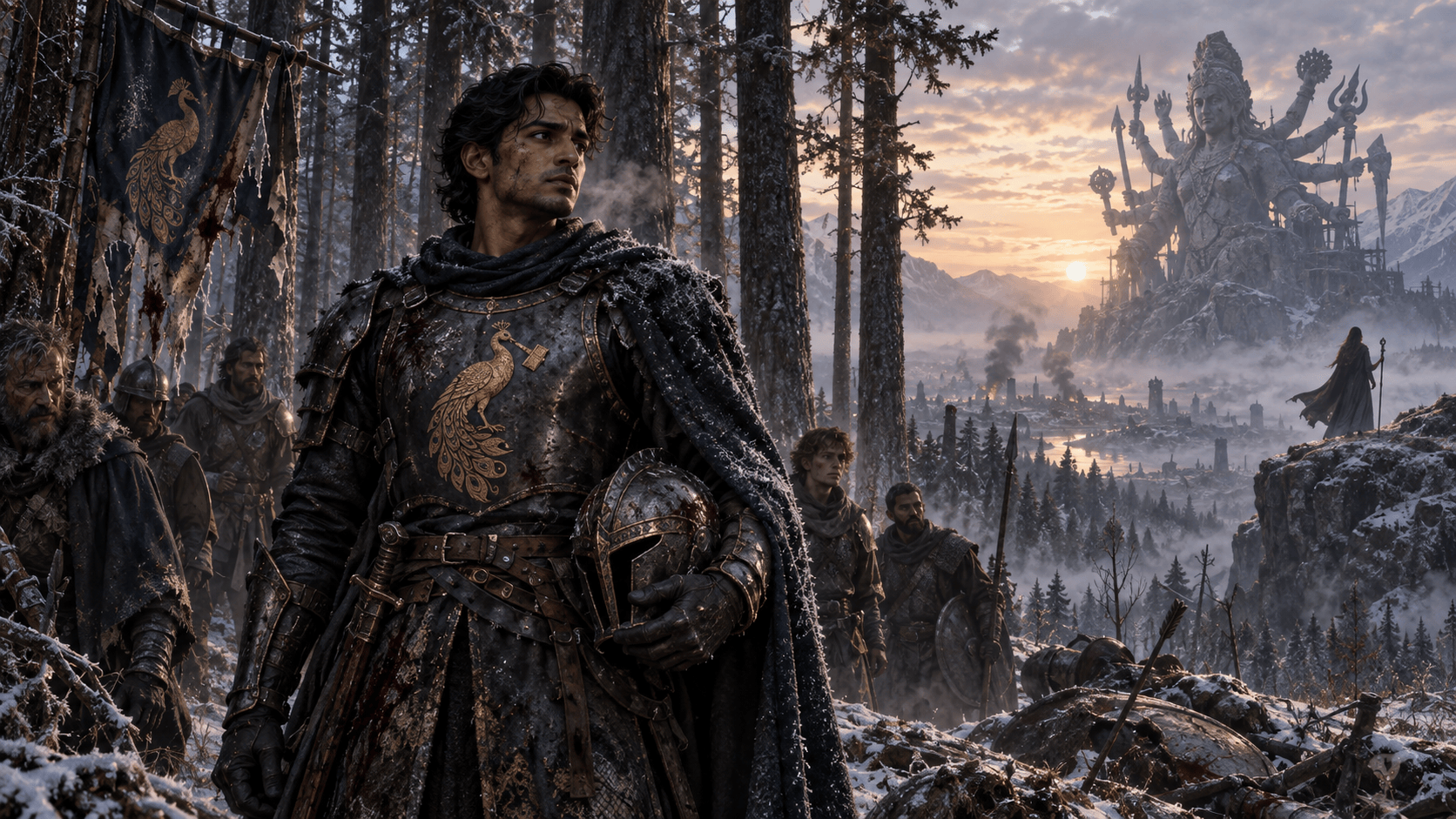
THE WITCH’S GAMBIT, CHAPTER 3
NEEDLE DROP: Blue Öyster Cult – “Astronomy” (1974)
OPENING CREDITS
CUT MUSIC.
A beat of silence.
FADE TO BLACK.
FADE IN:
EXT. PINEWOOD FOREST – BORDERLANDS – DAWN
Arjun Valekar woke beneath the pines with frost on his cloak and no sound but wind.
The forest stood straight and indifferent around him. Trunks rose like pillars into a pale morning, needles whispering softly overhead. His breath smoked once, then steadied. He did not reach for a weapon. He listened.
No voices. No horns. No orders.
The company was gone — scattered in the night, broken, or dead.
Arjun sat up and counted what remained.
He did it the way Raynor had taught him: without hope, without hurry. A torn banner snagged in the lower branches downslope.
Boot prints leading nowhere. A dark patch where someone had bled and been dragged — or had crawled. The forest had already begun to close around it all.
Arjun rose.
When he stood, men found him without being called.
They came from the trees in twos and threes, moving carefully, weapons low, eyes searching his face before they spoke. Veterans first. Then the younger ones. No one saluted. No one asked what to do.
They waited.
Arjun took a step downhill, then another, until the ground leveled into a narrow clearing where the pines thinned near exposed stone. There, half-covered by a fallen bough, lay his armor.
It had not been set out ceremonially. It had been dropped where he had last removed it — plate darkened by pitch and pine resin, straps stiff with cold. The cuirass bore a deep crease along the left flank, where a blade had glanced instead of bitten. Mud clung to the greaves. The helm lay on its side, visor dented, plume torn away.
Arjun knelt and began to dress.
He did not rush. He did not ask for help.
The men watched as he buckled the plates one by one, breath fogging the steel, fingers sure despite the cold. When he lifted the cuirass, the crest caught the thin light filtering through the branches.
A golden peacock, wings folded. In its beak, a hammer.
The gold was dulled by ash and travel, but it held. It always did. The peacock did not flare. It endured. The hammer was not raised. It was carried.
One of the younger soldiers shifted when he saw it, then stilled himself.
Arjun finished strapping the armor and stood again. The plate changed the way the forest received him. Sound fell away differently. Space adjusted.
He did not look at the men right away. He looked instead at the ground between them, at the frost already melting where boots had passed. He considered directions he would not take.
ARJUN
We’re not pursuing.
It was not loud. It was not a challenge.
No one argued.
ARJUN
We gather who we can.
We bury what we must.
We leave before dusk.
A pause. He looked up now, meeting their eyes one by one.
ARJUN
No banners.
A few heads nodded. Someone exhaled.
They moved when he stopped speaking.
Two men broke off toward the slope. Another turned back into the trees, already calling softly for names that might answer. Arjun lifted the helm, set it under his arm, and walked to the edge of the clearing.
Beyond the pines, the land fell away toward the border – low country veiled in distant smoke. A line the forest did not cross.
Arjun stood a moment longer, listening again – not for voices, but for what the day would allow.
Then he stepped forward.
The forest let him pass.
CUT TO:
EXT. ROAD OUT OF DHARYANA – MORNING
Carts creak eastward through churned mud.
Not refugees in panic — people leaving because it is over.
A FARMER walks beside his ox, leading rather than riding. A SOLDIER WITH A BANDAGED ARM limps alongside, helping guide the cart wheel through a rut.
FARMER
(low, cautious)
They say she never touched him.
The soldier doesn’t look over.
SOLDIER
Doesn’t matter.
A beat.
FARMER
They say she just looked.
The soldier stops walking. Considers that.
SOLDIER
Then he shouldn’t have been standing there.
They move on.
INT. SHATTERED SHRINE – LATE MORNING
A roofless roadside shrine. Half the idols smashed, half untouched — no pattern anyone can explain.
A WANDERING MONK kneels, binding his foot. A YOUNG WOMAN watches the road nervously.
YOUNG WOMAN
Is it true? About her eyes?
The monk ties the knot carefully.
MONK
Every god has eyes.
YOUNG WOMAN
Is she one?
The monk finishes. Stands.
MONK
No.
He looks toward Dharyana, distant now.
MONK
She’s what happens when gods stop answering.
EXT. RIVER CROSSING – NOON
A line of MERCENARIES waits to ford the river. Armor mismatched. Faces hard.
One spits into the water.
MERCENARY #1
They’re calling her Kali Eyes now.
Laughter from another.
MERCENARY #2
Figures. Everything’s Kali when it goes wrong.
A third mercenary, older, tightens his gauntlet.
MERCENARY #3
No.
They look at him.
MERCENARY #3
Kali ends things that won’t die on their own.
He steps into the river.
MERCENARY #3
If you’re afraid of her name, you were already on the wrong side.
No one laughs after that.
INT. BROKEN TEMPLE STORE ROOM – AFTERNOON
Two PRIESTS argue in low voices among crates and torn scrolls.
FIRST PRIEST
It’s blasphemy.
SECOND PRIEST
It’s convenient.
The first priest snaps his head around.
FIRST PRIEST
Careful.
The second priest lowers his voice further.
SECOND PRIEST
Names don’t spread unless they fit.
A pause.
SECOND PRIEST
And temples don’t fall silent unless something has been listening longer than we have.
Neither of them looks at the altar.
EXT. RIDGELINE ABOVE THE ROAD – EVENING
Theodora stands with her back to the setting sun. Cloak drawn close. Staff grounded.
She watches the road without interest — people moving, surviving, already forgetting details.
She does not know the name yet.
Behind her, one of her soldiers approaches, hesitant.
He stops short of speaking.
She senses him anyway.
THEODORA
Say it.
The soldier swallows.
SOLDIER
(low)
They’re calling you… something.
She turns her head slightly. Not toward him — toward the horizon.
THEODORA
Am I answering to it?
SOLDIER
No.
A beat.
THEODORA
Then it isn’t mine.
She steps forward, already moving on.
The soldier remains where he is, watching her go — unsure whether to feel relieved or afraid.
CUT TO:
MATCH CUT TO:
EXT. THE IDOL – DAWN
The same FORTY-FOOT IDOL.
But not as before.
No molten eyes.
No embers.
No kneeling host.
Morning light now — pale, indifferent — reveals what the fire once hid.
The stone is old.
Cracked.
Repaired in places with mismatched masonry.
The TEN ARMS are still spread wide.
Still armed.
But now we see the truth of them:
The axe is chipped.
The dagger dulled by rain.
The banner threadbare, its sigil half-eroded.
The chain broken long ago, not dramatically — worked apart.
The brazier cold, blue ash fused to stone.
The serpent staff bent not in submission, but in fatigue.
The bow strung with a cord replaced more than once.
The hourglass sealed shut — sand immobile, not frozen by magic but by age.
The empty hand is not defiant.
It is open.
The idol’s face — once wrath and radiance — now reads differently.
Not a goddess.
Not a tyrant.
A record.
The eyes catch the morning light.
They do not burn.
They reflect the land below — roads, smoke, people moving on.
Theodora passes through the bottom of frame, small, unmarked, already leaving the moment behind.
She does not look up.
The idol does not follow her.
It has never moved.
It will never move.
Leave a Reply